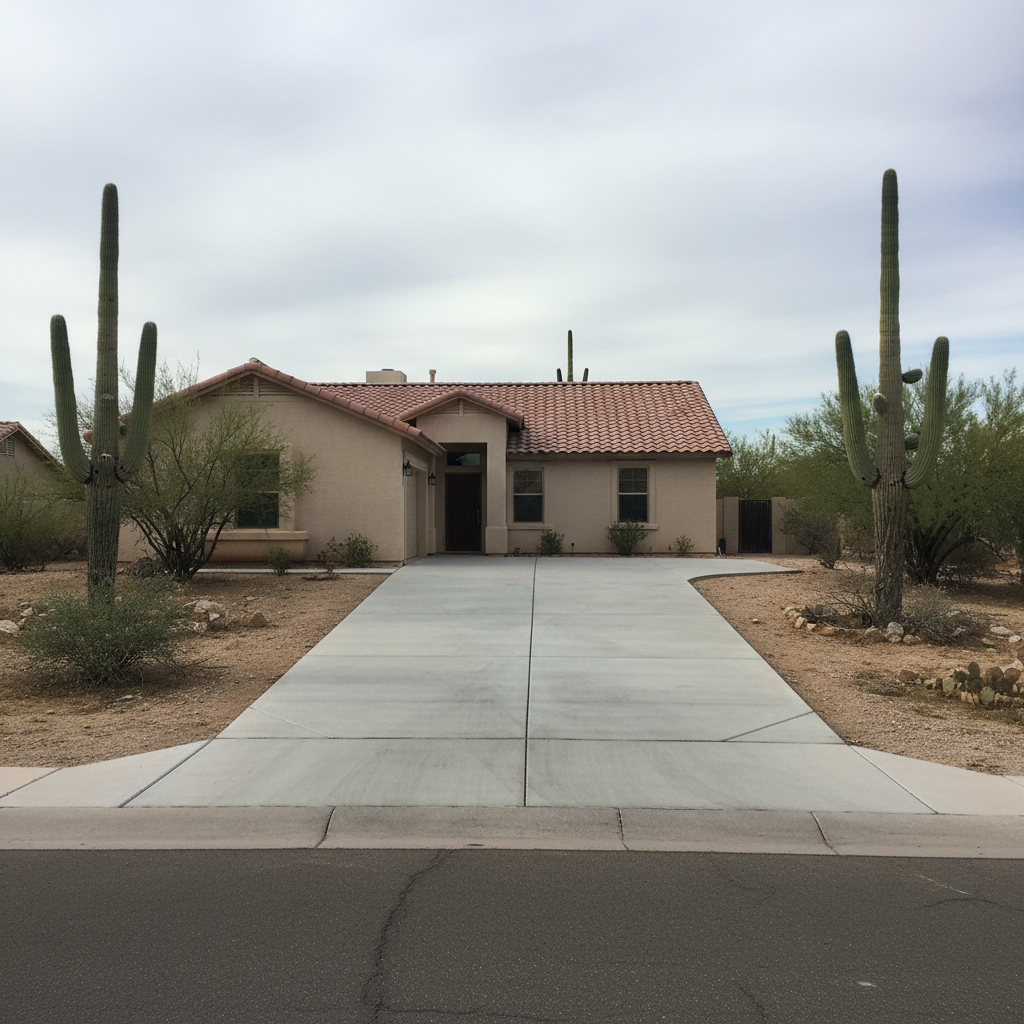
A driveway or a patio slab is one of the few things you buy for your house that you can't really return. Once it's poured and cured, fixing a bad job means jackhammering it out and starting over. That's expensive and it's loud and your neighbors will remember it for a year. So picking the right person to pour it matters more than picking the right person to paint a wall.
In Oro Valley, there are a few things specific to this ground and this climate that separate a contractor who knows what they're doing from one who's going to hand you a problem in three summers.
The soil here isn't like most places
A lot of Southern Arizona sits on caliche, a hardpan layer of calcium carbonate that can run anywhere from a few inches to a few feet below the surface. It's basically natural concrete already. A contractor who's worked here knows that a shovel doesn't cut it and that you sometimes need a jackhammer attachment or a breaker just to get a footing trench to depth. If a bid doesn't account for possible caliche removal, that's either because they haven't dug in this area before or because they're planning to charge you for it later as a surprise. Ask directly: "What happens if we hit caliche?" A contractor who's done footings in Rancho Vistoso or Stone Canyon has an answer ready. One who hasn't will shrug.
Caliche also doesn't drain. Water sits on top of it instead of soaking through, which matters for how a patio or driveway slab is graded. You want at least a 1/8 inch per foot slope away from the house, more in spots where runoff naturally collects. Get that wrong and you're not looking at a cracked slab, you're looking at water pooling against your foundation every monsoon.
Heat and monsoon season change how concrete is poured
Concrete cures through a chemical reaction, not by drying out, and in Oro Valley summer heat that reaction can run away from you. When slab temperatures get into the 90s and 100s, the surface can skin over and lose moisture faster than the concrete underneath is setting up. That leads to plastic shrinkage cracking, those fine hairline cracks that show up within hours of the pour. A contractor who pours through the summer here starts early, often before sunrise, uses evaporation retarders or wet burlap, and gets curing compound on the slab the same day, not the next one.
Then there's monsoon season, roughly July through September, where you can go from clear sky to a half-inch of rain in twenty minutes. A freshly poured slab that gets rained on before it sets can end up with a surface that's weak and dusty, sometimes called a "soft slab." Anyone pouring outdoor concrete between July and September should be watching the radar, not just the forecast from that morning. Ask how they handle a surprise storm. If the answer is "we cover it and hope," that's not a plan.
On the flip side, Oro Valley gets maybe a handful of nights below freezing each winter, so freeze-thaw cracking isn't the issue here that it is up north. That's one less thing to worry about, but it also means a contractor who learned the trade somewhere colder may be overbuilding for a problem you don't really have, instead of focusing on the heat and expansion issues you do.
Licensing, insurance, and how permits actually work here
Arizona requires a contractor's license through the Registrar of Contractors for most concrete work above a small dollar threshold. Ask for the license number and look it up yourself, it takes two minutes. Ask for proof of general liability insurance and worker's comp. If a slab settles into your sewer line or a worker gets hurt on your property, you don't want to find out afterward that neither was covered.
Depending on where your property sits, permits and inspections run through the Town of Oro Valley or Pima County. A new driveway apron that ties into a public right-of-way usually needs a permit and an inspection of the subgrade and forms before the pour. A structural slab, like a foundation or an addition, typically needs rebar or mesh inspected in place before concrete ever touches it, because once it's poured nobody can verify what's underneath. If a contractor tells you permits are a waste of time or money, that's a red flag, not a money-saving tip. It usually means they're not confident the work would pass.
A lot of Oro Valley neighborhoods, especially the newer ones like Rancho Vistoso, Stone Canyon, and parts of Naranja, have an HOA with design review for anything visible from the street, which can include driveway color, stamped patterns, and even aggregate finish. Older pockets of the area built before those HOAs existed don't have that layer, but they're more likely to have older utility lines or septic components buried where you're planning to dig. Either way, a contractor who's worked locally knows to ask about HOA approval and utility locates before they schedule a crew, not after.
What to ask before you sign anything
- How thick will the slab be, and is that 4 inches for a patio or walkway, or closer to 5-6 inches for a driveway that'll see vehicle weight?
- Rebar or wire mesh, and why that choice for this particular job?
- Where will control joints be cut, and how soon after the pour? Concrete is going to crack somewhere. Joints cut within the first 24 hours give it a place to crack on purpose instead of wherever it wants.
- How many days before you can walk on it, and how many before you can park a car on it? Concrete gains most of its strength in the first week but keeps curing for close to a month, which is why driveways usually need 7 days before light traffic and closer to 28 before you treat them like they're fully cured.
- What's in writing about the mix design, PSI rating, and whether they're using a ready-mix supplier or batching on site?
Walk away from a contractor who won't put any of this in writing, who wants full payment up front, or whose bid is dramatically lower than two others with no explanation. Concrete, rebar, and labor cost roughly what they cost. A number that's 30% under everyone else is usually missing a step, whether that's rebar, proper subgrade compaction, or enough curing time before the next phase starts.
What a fair warranty looks like
Nobody can promise a slab will never crack, concrete cracks, that's its nature. What a contractor can promise is workmanship on things within their control: proper thickness, correct jointing, adequate cure time, grading that moves water away from the house. A one or two year workmanship warranty is reasonable. A lifetime warranty with no specifics is usually marketing, not a real commitment, because by the time something shows up five years out it's hard to prove what caused it.
If you're weighing bids right now, ask each contractor to walk your site with you and point out exactly where the water will go in a heavy monsoon downpour, and what they'll do differently because of the soil under your particular lot. That one conversation tells you more than any brochure. We've done that walk-through on plenty of properties around town, and it's part of how Atlas Concrete Company prices a job before anyone signs anything.