Our Work
Recent Projects
A few jobs we've poured recently.
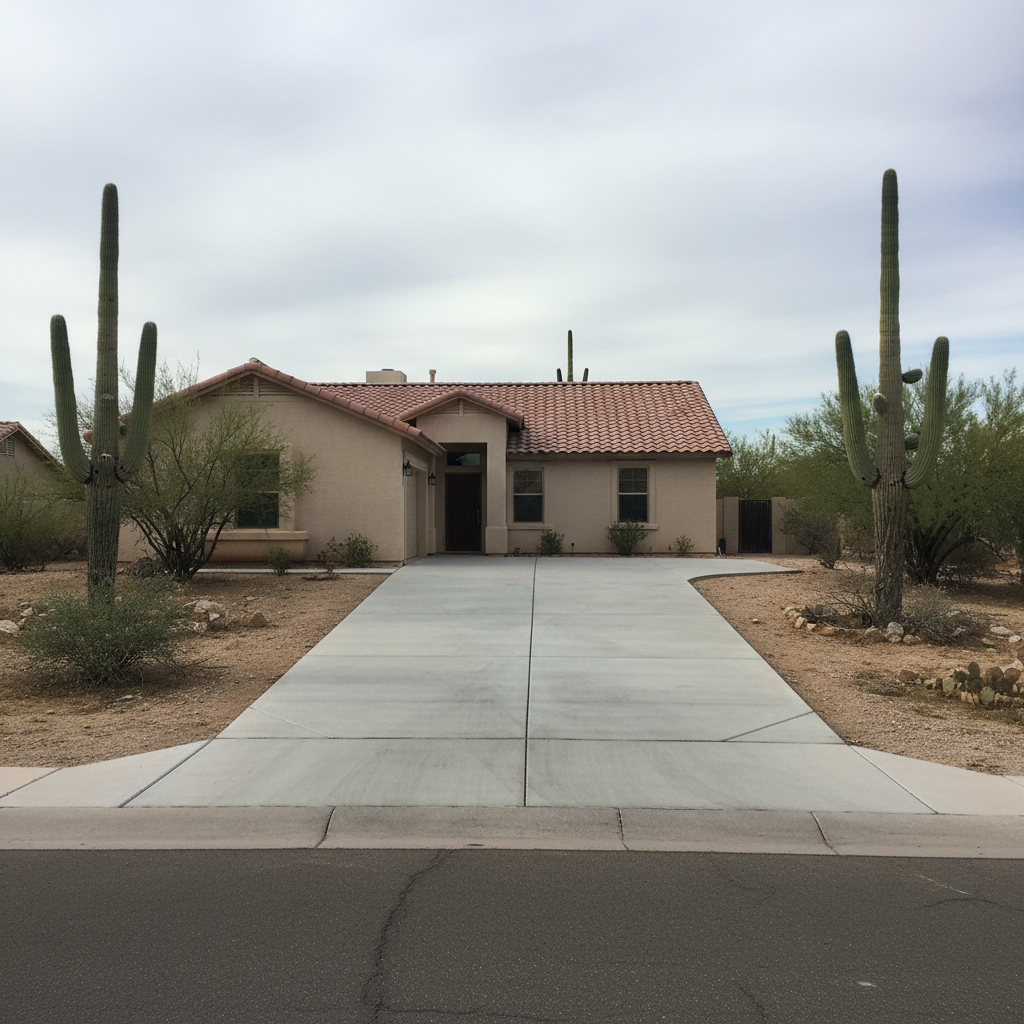
Every job below is one we do ourselves across Oro Valley.
We form and pour driveways thick enough to carry daily vehicle weight without cracking in the first year. Rebar goes in on anything taking real traffic, mesh alone isn't enough once the subgrade shifts. We grade for drainage so water runs off instead of pooling against your garage door.
Patio slabs sit outside all day in direct sun, so we broom or trowel finish depending on how much heat you want it holding. We slope every patio away from the house, even a quarter inch per foot keeps water from backing up at the threshold. Add a shade structure later and the slab's already rated to carry the footings.
Stamped concrete gets you the look of flagstone, brick, or tile without the joints where weeds and ants move in. We color the slab integrally or with a release agent before stamping, then seal it so the desert sun doesn't bleach it out in a year. It costs more than plain gray concrete, worth knowing up front.
Spalling, surface cracks, and settled corners get patched, ground down, or cut out and re-poured depending on how deep the damage runs. A hairline crack that isn't moving usually just needs sealing. A slab that's dropped an inch at one corner means the base failed, and patching won't fix that, we'd need to cut it out.
Shed, garage, and addition slabs get poured on compacted base with vapor barrier underneath where it matters. We check compaction before the truck ever shows up, a soft spot under the slab is where the crack starts six months later.
Walkways get poured in sections with control joints every four to six feet so the concrete cracks at the joint instead of across the middle of a panel. We keep the surface broom-finished for grip, smooth concrete gets slick when it's wet.
If the slab underneath is sound but the surface is pitted, stained, or spalling, resurfacing with an overlay saves tearing it all out. It's a thin layer, an inch or less, so it only works if there's no structural cracking underneath. We'll tell you honestly if your slab is past that point.
Exposed aggregate gives you a textured, non-slip surface by washing off the top layer of cement paste before it fully cures, exposing the stone underneath. It holds up well around pools and entryways where plain concrete gets slippery. Timing the wash-off right is the whole job, too early and the stone pulls loose, too late and it won't expose at all.
Steps and porch slabs get formed to exact rise and run so they meet code and don't trip anyone up. We tie new steps into the existing foundation with rebar dowels instead of just butting concrete against concrete, which is where most porch steps eventually separate and crack.
Sometimes a slab is too far gone to patch, heaved by a tree root, cracked through in a dozen spots, or poured without rebar thirty years ago. We break it up, haul it off, and start over with a proper base and reinforcement. Full replacement costs more up front than repair, but it's the right call when the damage is structural.
Four steps, and no surprises in any of them.
You tell us what you want doing, we look at what is actually there, and we ask the awkward questions early.
In writing, itemised, free. If something might add cost later we flag it now rather than at the end.
Same crew throughout. We cover your floors, keep the dust down and tidy up before we leave each day.
You point out anything you are not happy with and we fix it before the invoice, not after.
A few jobs we've poured recently.
We bring the same crew and equipment to every town on this list.
Questions that come up once a project's actually underway.
Describe the problem and we will tell you what it probably is. No obligation.